MSG OPS

  • sector

  • Publicity

  • Role

  • Product Designer

  • Type

  • Mail leads operational system

  • timeline

  • 2021

Ghosted Memory is a visual dissection of memory decay in a digitized world. The project blends analog textures with facial distortion and archival imagery, exploring how memory becomes a fragmented narrative under digital compression. Part memoir, part visual theory, this piece channels themes of distortion, loss, and unreliable recollection.

A portrait of a person with their face mirrored and vertically stretched, surrounded by archival papers and grainy textures. Dreamlike and disorienting.

Design strategy


At the heart of this project was the intention to confuse clarity with artifact. Each image was constructed using scans, photocopies, and analog paper pieces, then reworked through digital filters to simulate visual echoes. Design choices were deliberately anti-clean—prioritizing texture, blur, and ambiguity over resolution or polish. The face—a symbol of recognition—was obscured deliberately to challenge the viewer’s instinct to reconstruct what’s familiar.


Systems of distortion


Repetition and symmetry were used as metaphors for mnemonic loops. Mirrored compositions and circular cuts referenced the cognitive process of trying to recall something you’ve forgotten—looping endlessly without resolution. Graphic elements were layered to reinforce a sense of visual déjà vu, mimicking the way memories degrade with each retelling. Visuals were iterated until they felt both hypnotic and unstable.
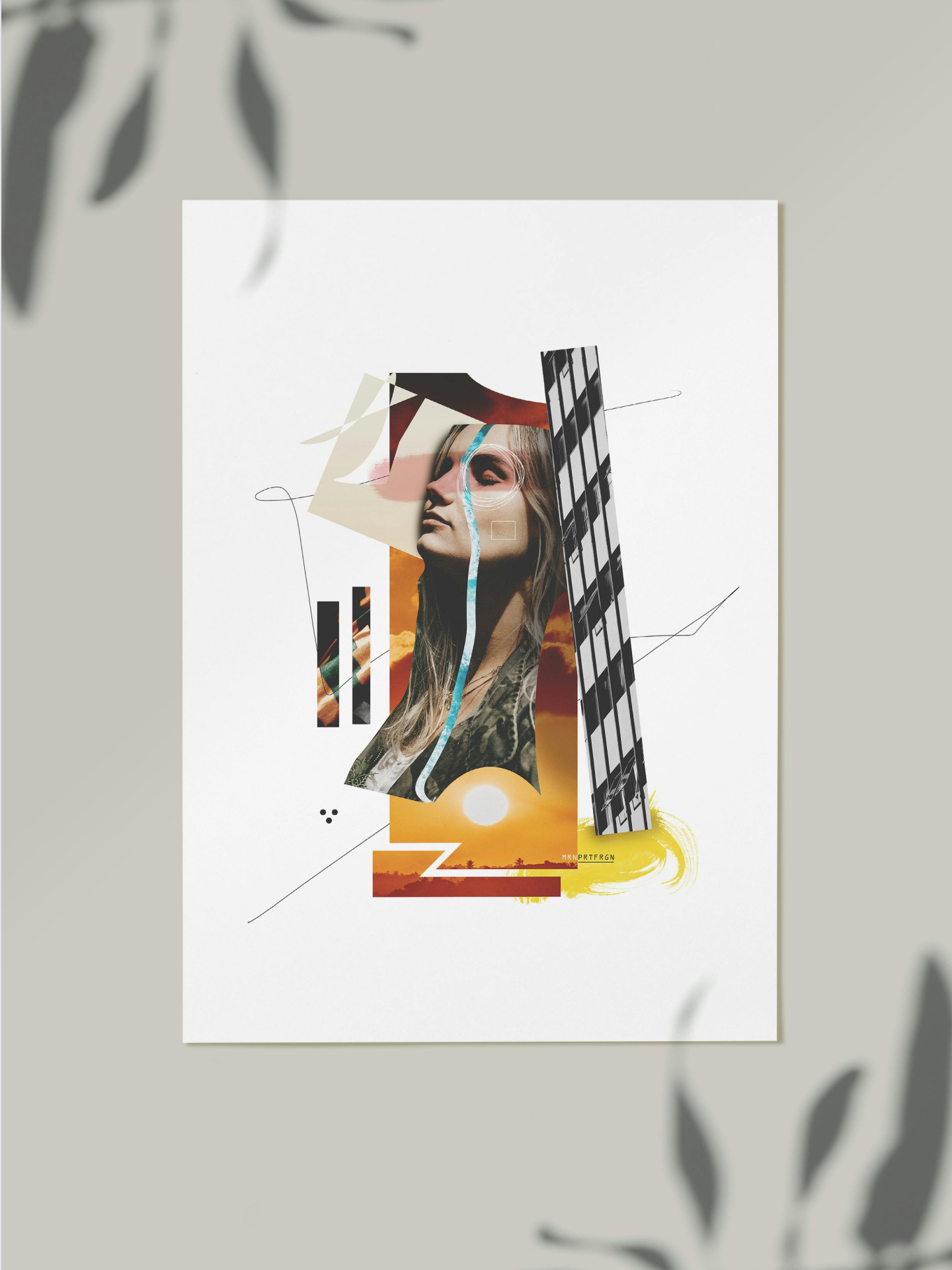


Mixed-media collage featuring a woman’s portrait layered with geometric shapes, a black-and-white building fragment, abstract lines, and a sunset landscape, arranged on a white sheet with plant shadows cast around the edges.


Material process


Unlike digital-first work, Ghosted Memory emphasized tactile creation. Hand-cut elements, scanned annotations, and grainy overlays lent the work an archival quality. Materials were selected not only for their texture but for their emotional resonance—postcards, printed ephemera, and xeroxed portraits. This physicality grounded the work and provided tension between ephemeral memory and tangible media.


Outcome


Ghosted Memory served as a catalyst for broader explorations into identity, perception, and the aesthetics of error. The project was exhibited in a small-run zine format and shared across visual culture blogs focused on experimental design. It remains a cornerstone of the designer’s portfolio, illustrating an ongoing interest in how design can visualize psychological processes.

  • Image of a young white woman looking at her phone with the Where to Go app opened on maiin page
  • Project 01

    Where to go

  • Industrial worker surronded by steel checking his phone
  • Project 02

    Gatherer

  • High-contrast yellow halftone pattern with diagonal streaks, emulating risograph print textures. Abstract and energetic.
  • Project 03

    Connected Machines

Let’s chat

© 2025

Home

Work

About

Mari Andrade

Back to projects

MSG OPS

  • sector

  • Publicity

  • Role

  • Product Designer

  • Type

  • Mail leads operational system

  • timeline

  • 2021

Ghosted Memory is a visual dissection of memory decay in a digitized world. The project blends analog textures with facial distortion and archival imagery, exploring how memory becomes a fragmented narrative under digital compression. Part memoir, part visual theory, this piece channels themes of distortion, loss, and unreliable recollection.

A portrait of a person with their face mirrored and vertically stretched, surrounded by archival papers and grainy textures. Dreamlike and disorienting.

Design strategy


At the heart of this project was the intention to confuse clarity with artifact. Each image was constructed using scans, photocopies, and analog paper pieces, then reworked through digital filters to simulate visual echoes. Design choices were deliberately anti-clean—prioritizing texture, blur, and ambiguity over resolution or polish. The face—a symbol of recognition—was obscured deliberately to challenge the viewer’s instinct to reconstruct what’s familiar.


Systems of distortion


Repetition and symmetry were used as metaphors for mnemonic loops. Mirrored compositions and circular cuts referenced the cognitive process of trying to recall something you’ve forgotten—looping endlessly without resolution. Graphic elements were layered to reinforce a sense of visual déjà vu, mimicking the way memories degrade with each retelling. Visuals were iterated until they felt both hypnotic and unstable.


Mixed-media collage featuring a woman’s portrait layered with geometric shapes, a black-and-white building fragment, abstract lines, and a sunset landscape, arranged on a white sheet with plant shadows cast around the edges.


Material process


Unlike digital-first work, Ghosted Memory emphasized tactile creation. Hand-cut elements, scanned annotations, and grainy overlays lent the work an archival quality. Materials were selected not only for their texture but for their emotional resonance—postcards, printed ephemera, and xeroxed portraits. This physicality grounded the work and provided tension between ephemeral memory and tangible media.


Outcome


Ghosted Memory served as a catalyst for broader explorations into identity, perception, and the aesthetics of error. The project was exhibited in a small-run zine format and shared across visual culture blogs focused on experimental design. It remains a cornerstone of the designer’s portfolio, illustrating an ongoing interest in how design can visualize psychological processes.

  • Image of a young white woman looking at her phone with the Where to Go app opened on maiin page
  • Project 01

    Where to go

  • Industrial worker surronded by steel checking his phone
  • Project 02

    Gatherer

  • High-contrast yellow halftone pattern with diagonal streaks, emulating risograph print textures. Abstract and energetic.
  • Project 03

    Connected Machines

Let’s chat

© 2025

Home

Work

About

Mari Andrade

Back to projects

MSG OPS

  • sector

  • Publicity

  • Role

  • Product Designer

  • Type

  • Mail leads operational system

  • timeline

  • 2021

Ghosted Memory is a visual dissection of memory decay in a digitized world. The project blends analog textures with facial distortion and archival imagery, exploring how memory becomes a fragmented narrative under digital compression. Part memoir, part visual theory, this piece channels themes of distortion, loss, and unreliable recollection.

A portrait of a person with their face mirrored and vertically stretched, surrounded by archival papers and grainy textures. Dreamlike and disorienting.

Design strategy


At the heart of this project was the intention to confuse clarity with artifact. Each image was constructed using scans, photocopies, and analog paper pieces, then reworked through digital filters to simulate visual echoes. Design choices were deliberately anti-clean—prioritizing texture, blur, and ambiguity over resolution or polish. The face—a symbol of recognition—was obscured deliberately to challenge the viewer’s instinct to reconstruct what’s familiar.


Systems of distortion


Repetition and symmetry were used as metaphors for mnemonic loops. Mirrored compositions and circular cuts referenced the cognitive process of trying to recall something you’ve forgotten—looping endlessly without resolution. Graphic elements were layered to reinforce a sense of visual déjà vu, mimicking the way memories degrade with each retelling. Visuals were iterated until they felt both hypnotic and unstable.


Mixed-media collage featuring a woman’s portrait layered with geometric shapes, a black-and-white building fragment, abstract lines, and a sunset landscape, arranged on a white sheet with plant shadows cast around the edges.


Material process


Unlike digital-first work, Ghosted Memory emphasized tactile creation. Hand-cut elements, scanned annotations, and grainy overlays lent the work an archival quality. Materials were selected not only for their texture but for their emotional resonance—postcards, printed ephemera, and xeroxed portraits. This physicality grounded the work and provided tension between ephemeral memory and tangible media.


Outcome


Ghosted Memory served as a catalyst for broader explorations into identity, perception, and the aesthetics of error. The project was exhibited in a small-run zine format and shared across visual culture blogs focused on experimental design. It remains a cornerstone of the designer’s portfolio, illustrating an ongoing interest in how design can visualize psychological processes.

  • Image of a young white woman looking at her phone with the Where to Go app opened on maiin page
  • Project 01

    Where to go

  • Industrial worker surronded by steel checking his phone
  • Project 02

    Gatherer

  • High-contrast yellow halftone pattern with diagonal streaks, emulating risograph print textures. Abstract and energetic.
  • Project 03

    Connected Machines

Let's chat